new the gold heart meditation ☆~♡~ aaurelia gold heart , a novel by narayan , read it!~☆~♡in the living library crone with a machete !☆~♡~astro scope in the living libraray ~♡~
Crone with a Machete ~ There’s No Place Like Home. Bring a Machete.
Narayan *
Share
There’s No Place Like Home. Bring a Machete.
well that was a shit show, lets go home
Because sometimes finding your way home requires more than clicking your heels.
We all have a lens through which we view the world.
The question is: What is your lens made of?
How is it that you see what you see—and do not see what you do not see?
Some will say cognitive dissonance. Some will say upbringing. Some will ring the trauma bell very loudly, and because it is trauma, whatever point of view a person holds is suddenly excused. The lens may be distorted, but the distortion is justified.
Apparently, once trauma enters the room, it gets to rearrange all the furniture.
Then there is childhood. The way you were raised. The things you were taught in school. Your religion. Your neighborhood. Your family dynamics. Your losses and betrayals. Your successes. Your failures. Your political affiliations. The people you admire and the people you have decided to hate.
So many things contribute to the lens through which you view the world.
But the question I have for you is this:
Is it really your lens?
Is this truly how you see the world—or are you still looking through a lens that was handed to you?
I used to be very black-and-white. Hard-edged black-and-white. Good or bad. Right or wrong. Evil or righteous. My team or your team.
Mine.
I am a Taurus. We like mine.
I grew up in a house where I was bullied by my brothers all day, every day—and they will admit that this is true. It was sport in our house. That shaped the way I viewed the world.
A narcissistic mother shaped the way I viewed the world.
And yes, there were flying monkeys.
I did not know that term then. I thought flying monkeys belonged exclusively to Oz. It turns out they can live in perfectly respectable suburban houses, carry out their assignments without wings, and still make it home in time for dinner.
An alcoholic father who owned a beauty salon , that shaped the way I viewed the world.
Growing up in San Diego, in a nice, comfortable, middle-middle-class suburb, shaped the way I viewed the world. There was upper-middle-class wealth around the corner and even greater wealth beyond that because it was San Diego, and money was everywhere.
That was the world I was given to look at.
But even as a child, I wondered about it.
I would sit on the curb and ask myself, How did I get here?
How did I get here?
In some ways, I was Dorothy in reverse. She landed in a strange world and wanted to know how to get home. I was sitting in the place everyone told me was home, wondering how I had landed there in the first place.
How was I not a child starving in Africa? I knew there were starving children in Africa because we received National Geographic. The magazines were piled in our garage like collector’s items, filled with photographs of lives radically different from mine.
Why was this the street I was sitting on?
Why was this what I got to see?
There was no visible Yellow Brick Road running through our neighborhood. Just pavement, curbs, tidy lawns, and rows of houses. But I sensed that the ordinary street in front of me belonged to a much larger map.
I would look up and down it, studying each house as if I were studying the people living inside it. I was examining the individual households, but I was also examining humanity. Even then, I understood that every house contained a world of its own.
I did not yet have a machete.
But I was already looking for the road.
You eventually leave your childhood street and move into the larger world. Your view either widens—or it does not.
Sometimes it shrinks.
Your scope can become smaller and smaller until you are looking at the entirety of existence through one tiny porthole. Or it can continue to widen as you travel, encounter people, gather knowledge, survive experiences, and allow what you discover to change you.
Perhaps this is why people love to travel. They want to widen their scope. They want to see what cannot be seen from the curb of the street where they were raised.
But widening the lens is not something that happens simply because you board an airplane. You can travel around the entire planet and bring the same tiny porthole with you.
You can follow the Yellow Brick Road from one end of Oz to the other and still see only what you expected to see when you began.
We have all met that person, and have been that person.
You have to tend to the lens.
How dirty is yours?
Do you ever clean it? Do you wipe the grime from it? Do you open it and close it to make sure it still works? Oil the mechanism's so they still work.
Can you dial it in very closely and then pull it all the way back?
Can you examine the details of a situation—the specific people, the individual facts, the history, the different points of view—and then come back out again to see the full scope of what is happening?
Can you look at one specific detail without mistaking it for the whole?
Can you examine a collection of specificities and understand how they fit together?
Or has your lens rusted into place like the Tin Man—unable to turn its head, much less change its mind?
Are you looking through one small porthole that can show you only what you have already decided you should, could, or are willing to see? Is everything outside that view deemed evil, wrong, stupid, dangerous, or simply nonexistent because it does not fit what your mind wants to believe?
What shaped your lens?
And perhaps more importantly: What narrowed it?
I do not like humanity very much right now.
I am just going to say it. I just did.
But I love humanity.
I love this planet. I love Mother Nature. I love Father Cosmos. I love the way the planets move within this harmonious, chaotic magnificence that stimulates our bodies, the plants, the birds, the bees, and the animals.
I look at it all and think, Wow.
And then we add the humans, and suddenly everything feels different.
So yes, I love humanity—but I do not particularly like them right now.
That is allowed.
A crone can love humanity and still occasionally want humanity to go sit quietly in the corner and think about what it has done.
I do not like how tightly everyone has dialed in the scope. I do not like how unwilling people have become to pull the lens back and consider that what they see may not be all there is to see.
My own point of view comes from having pulled that scope out very wide.
I was examining humanity when I was a child. I could look at a house and know things. I did not necessarily know how I knew. I simply knew.
That is gnosis.
I have spoken about gnosis before. We all possess the ability to know.
Think about Wi-Fi. How is my phone communicating with the box inside my house while I am sitting out here in my greenhouse? Something is moving through the air. Information is being carried through a field we cannot see.
We accept invisible communication when a little box delivers it, but suggest that the human body might receive information through an unseen field and suddenly everyone becomes very sophisticated.
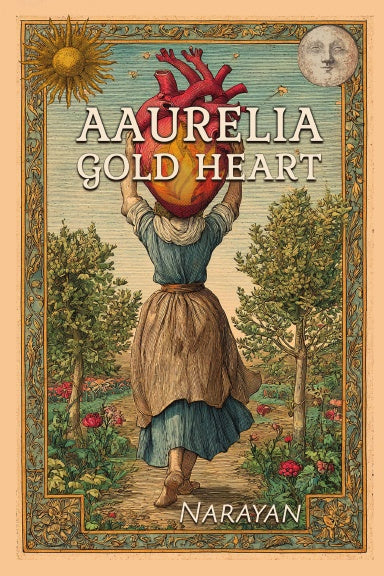
I wrote in Ariella Gold Heart that anything you want to know is a breath away.
You can breathe in information.
You can breathe with a question. You can become quiet enough to hear what is moving beneath all the noise.
I went through a period in my life when I consumed knowledge voraciously. I did not go to college, but I have always possessed a deeply curious mind. I genuinely love learning, and I am still learning—always. I believed knowledge was power, and I wanted to empower myself with as much knowledge and information as I could gather.
I love information. I still do.
It is probably why I have such a love-hate relationship with social media. It does not do me any favors in the algorithms, but I still enjoy the exchange of information. We are consumers—not only of products, but of ideas, images, stories, outrage, fear, beauty, and one another’s perspectives.
Then I learned about the heart.
I learned how to settle into it. Nobody formally taught me this. I learned to breathe, feel, and listen.
Look at the situation.
Breathe.
Feel.
Listen.
And you will know things.
That is gnosis.
But you cannot access that knowing through a narrow, tightly constricted scope that has never opened itself to the magnificence of all that is. You cannot understand the whole while refusing to look at the dark, the shadow, and the ways in which shadow carves the light, making it stronger and brighter.
The light cannot shine without the dark.
There are many little quippy New Age sayings that eventually fall by the wayside, but some endure because they contain truth.
This is one of them.
Without the dark, there is no light.
I have been chiseled by so much darkness that I am sometimes surprised I am still standing—or at least that I am not in jail.
I am not a violent person. Slandering someone to get ahead is not my way. Even in the way I have marketed my work around vaccines and the pharmaceutical industry, I have tried to remain conscious of how far down the road of campaigning against something I am willing to go.
I speak critically of Big Pharma because I believe harm has been done and should be named.
But I also understand this:
As long as you are working against something, you are not fully working for something.
And so I choose to place most of my attention upon what I am here to bring to people.
The expansion of the heart.
The expansion of knowledge.
The plants, practices, and possibilities that may support us.
That does not mean my scope is narrow. It does not mean I am ignorant of what is happening in the dark. I have seen the dark. I know how dark it can become.
I have simply chosen where to turn my attention.
And that is different from refusing to see.
You must widen the scope before you can consciously decide where to place your attention.
Since 2020, we have faced a great deal of darkness.
Many of us have looked darkness directly in the face and have had to live with the fallout of what we saw. Others have turned a blind eye and pretended it does not exist because they want to return to the comfort of whatever was happening in February of 2020.
They want to remember the good times. They want to live within the nostalgia of an era that is gone. They want to return to the ignorance they once possessed—or the ignorance behind the choices they made.
And so they narrow the scope.
They tighten the lens until they can no longer see beyond what those choices have brought them. They cannot examine where their narrow view in March of 2020 has led them today because doing so would require them to look at too much.
Others pulled the lens out so wide that it left them a little wonky, ungrounded, and unsettled.
I understand that too.
That is part of the process.
Everyone thinks awakening is about waking up to the light.
Nah.
The awakening is to the darkness.
You have to face it within yourself. You have to face it within humanity, within the political system, and within all the systems we have been taught to trust. You have to take your tweezers and pick your way through them, examining how they work, how they fail to work, and how often they work against the very people they claim to serve.
It is tedious work.
Apparently, awakening comes with tweezers, reading glasses, and a great deal of muttering under one’s breath.
The systems—the matrix, if you prefer—are not working for us.
For many, 2020 was the moment the curtain came down and discovered that the great and powerful voices booming through the room were not necessarily great, powerful, or even particularly wise.
Sometimes the wizard is simply a frightened little man operating machinery behind a curtain.
And once you have seen the machinery, it is difficult to go back to admiring the smoke.
Once you recognize that, the lens begins to pull back again.
You ask, What else is there?
Because this cannot be the complete picture.
And it is not.
To step outside the matrix, you have to widen your scope beyond its systems, its institutions, its authorities, and even its sacred books. Beyond the Bibles. Beyond the books. Beyond the ideas someone else handed you and told you were the boundaries of existence.
And once again, we return to gnosis.
But there is another lens we have not yet spoken of.
It is not the lens of the mind, sharpened by argument and crowded with everything we have consumed. It is not the lens of our upbringing, our trauma, our political loyalties, or even our accumulated knowledge.
It is the eye within the heart.
Mystics across traditions have spoken of this inner place of perception, although they have given it different names. The Upanishads speak of the cave or ether within the heart, where the Self and its light may be known. Christian scripture speaks of having “the eyes of your heart enlightened.” The Sufis speak of basirah—an inner seeing that does not depend upon the physical eyes.
These traditions are not identical, and I am not interested in pouring them all into one large spiritual soup and pretending they said precisely the same thing.
But they do appear to recognize something that the modern world has forgotten:
The heart is not merely a place where we feel. The heart is an organ of perception.
Perhaps this is also why the image of the eye of the needle has endured. It is the narrow opening through which the inflated, accumulated, heavily burdened self cannot pass unchanged.
You cannot drag the whole matrix through the eye of the needle.
You cannot bring every certainty, affiliation, grievance, possession, identity, and piece of programming with you. Something has to be surrendered. Something has to become small enough, quiet enough, and unburdened enough to pass through.
And on the other side is the eye within the heart.
This is the lens that gives us the widest view.
Paradoxically, we reach it by going inward.
We enter the small chamber within the heart and discover that it is not small at all. The Upanishads describe the Self within the heart as smaller than a seed and greater than the earth and the heavens.
It is the tiny aperture through which an entire cosmology becomes visible.
The mental lens looks outward from one fixed position. It stands in the center of its own history and interprets everything according to what has already happened to it.
The eye of the heart does not stand in one fixed position.
It sees around.
It sees beneath.
It sees within.
It allows us to perceive the detail and the whole at once. It can see the wound without reducing the person to the wound. It can see the darkness without believing darkness is all that exists. It can recognize the matrix without granting the matrix dominion over the whole of creation.
This is the 360-degree view.
It does not mean that we suddenly know everything or that our interpretations become infallible. The ego would love to take possession of the eye of the heart, put on a crown, and declare itself spiritually omniscient.
The ego does enjoy a promotion.
But that is just another dirty lens.
The heart’s eye does something much quieter. It allows us to remain receptive. It lets us see beyond the narrow porthole of our conditioning without pretending we are standing outside all conditioning forever.
We breathe.
We feel.
We listen.
We look again.
And the cosmology begins to reveal itself.
This is where the story of Oz holds a truth much larger than a pair of fabulous shoes.
Dorothy followed the road looking for someone powerful enough to send her home. The Scarecrow wanted a brain. The Tin Man wanted a heart. The Lion wanted courage. Each believed the missing piece had to be bestowed by an authority waiting at the end of the road.
But the wizard could not give them what they did not already possess.
The journey revealed it.
That is the part we forget.
The road does not hand you your power. The road puts you through enough that you finally recognize the power that was already yours.
When you pull the lens out far enough—and enter the heart deeply enough—you begin to glimpse an entirely different cosmology.
One that the matrix itself exists inside of.
Inside of.
The matrix does not want you to know that there is a greater cosmology holding it. It wants to present itself as the entirety of reality.
And to be fair, it has excellent branding.
Emerald towers. Smoke. Thunder. Large disembodied heads.
The usual.
It became very large. It became very convincing. It inserted itself between us and nearly everything natural, sacred, and holy.
It hijacked the lens.
But it did not create the cosmology.
The cosmology was already here.
Mother Nature and Father Cosmos, experienced through the human heart.
Through the eye of the heart, they are not three separate things. They are one field of relationship, communication, and creation.
When you begin to grasp that—when you receive even the smallest glimpse of it—you think, Whoa. There is something else here.
This is how we begin to live in the new—not because this cosmology is new, but because our ability to perceive it is new.
Or perhaps renewed.
This is not a return to some imagined golden age. It is not a return to the comfort of February 2020. It is a return to the original cosmology that existed before our human systems attempted to explain it, control it, divide it, package it, and sell it back to us.
Mother Nature below us.
Father Cosmos above and around us.
The living heart within us.
Now, let us be clear: the matrix is still over there running its game. It will still come and slap you upside the head from time to time. We still have rent to pay. We still need roofs over our heads. We still have to move through systems that can be tedious, invasive, and sometimes downright hostile.
Some people have found ways to live almost entirely outside them. I have not.
As I said, I am a Taurus. I like my comforts.
And so I do the little things I must do within the system so that, as much as possible, I do not have to belong to it.
The question becomes: When do you fight? When do you refuse? When do you comply just enough to get through what must be done so that you can return to your own cosmology?
This is where the eye of the heart becomes more than a mystical idea.
It becomes discernment.
It tells you when the machete is needed and when you are simply hacking at the forest because you are angry.
There is a difference.
A crone learns that difference—usually after wearing herself out a few times fighting things that were never going to become her path.
That larger cosmology does not erase darkness or duality. It does not make the matrix disappear. It simply puts the matrix back into perspective.
It reveals that the matrix is not the whole world.
It never was.
It was allowed to play its game within something much older, wider, and more magnificent than itself. It distracted us from that living cosmology because remembering it would return us to our power.
So take up your own machete.
Not to spend the rest of your life hacking away at humanity. You will exhaust yourself, and humanity will continue being humanity.
Use the machete where it is most powerful.
Hack away at the programs that were planted inside you. Cut through the fears that keep you obedient, the old hurts that keep you small, and the anger that keeps you permanently tethered to whatever wounded you. Cut the cords to the systems, stories, and identities that convinced you they were the whole of reality.
The machete is not merely a weapon. In the hands of the crone, it is a tool of discernment. She knows what must be confronted, what must be cleared, and what no longer deserves another ounce of her life force.
Use it to carve an opening.
Use it to extract yourself from the matrix—not because you can avoid every bill, rule, or earthly inconvenience, but because the matrix no longer gets to occupy the sacred center of your being.
Cut yourself free.
Then follow the Yellow Brick Road back to the original cosmology.
By now, it may not look like the road you remember. The bricks may be cracked. The weeds may have pushed through. The wildflowers may have overtaken the edges, and entire sections may have been reclaimed by the forest.
Good.
Perhaps Mother Nature has been showing us the way home all along.
Mother Nature beneath your feet.
Father Cosmos above your head.
And the eye of the heart, open within you, showing you the way.
This is why you must clean the lens.
This is why you must be able to dial it in and pull it back out. You need to see the individual game being played, but you must also recognize the greater field in which the game exists.
Look closely enough to understand what is happening.
Then enter the heart deeply enough to remember who you are.
Because the matrix wants you narrowly focused, endlessly reacting, and perpetually consuming.
But Mother Nature and Father Cosmos remind you that you are not merely a consumer trapped inside a system.
You are a creator inside a living cosmology.
The mind cannot hold the whole of it.
But the heart can behold it.
There is no place like home.
But sometimes clicking your heels is not enough.
Sometimes you have to bring a machete.
Narayan
the third dimensions ruff , get a helmet ...or a machete
Share
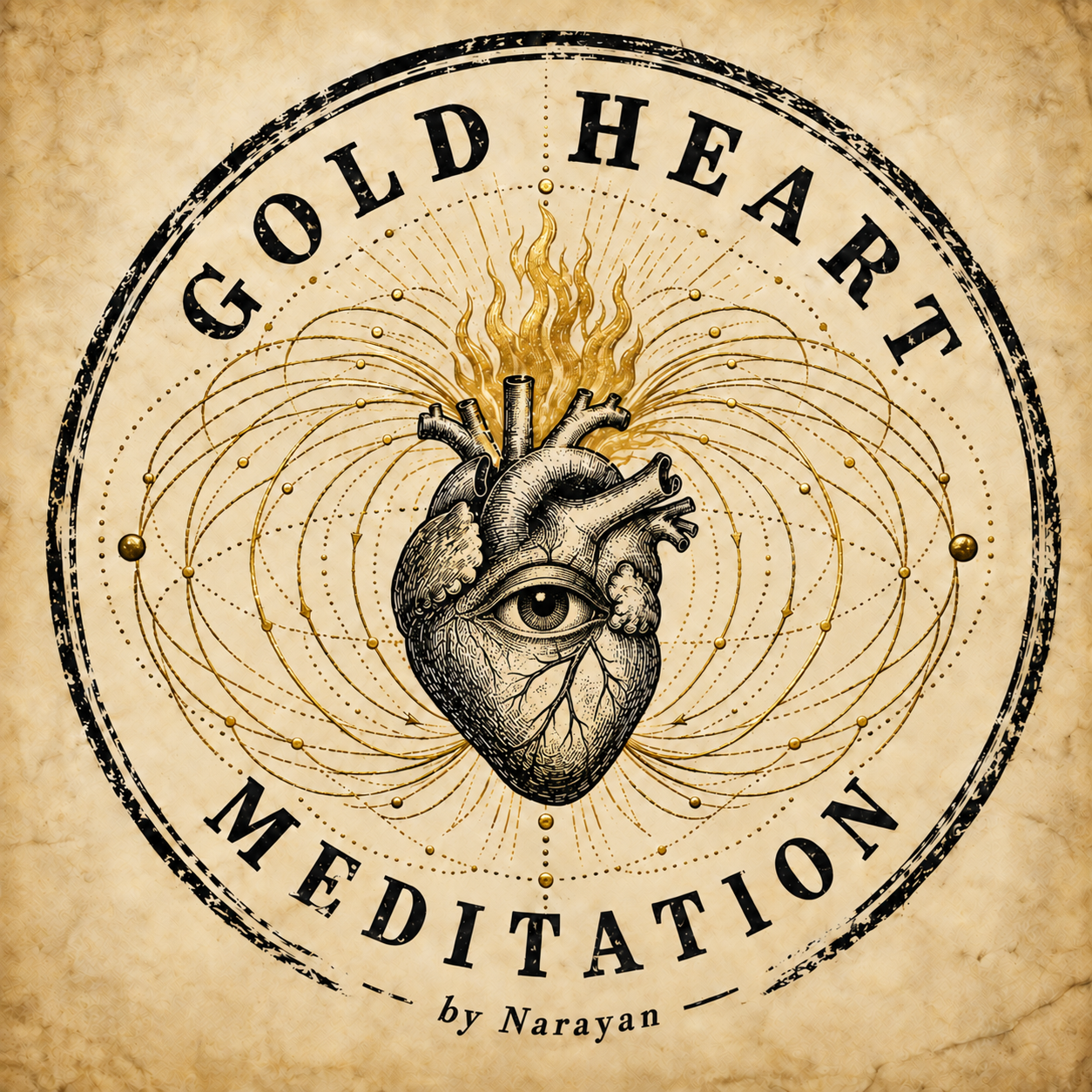
GOLD HEART MEDITATION
If the eye of the heart is the lens through which we remember the greater cosmology, then the Gold Heart Meditation is an invitation to enter it. This guided journey takes you beyond the noise of the mind and into the living chamber of the heart, where you can breathe, feel, listen, and remember. The road home was never somewhere outside you. It has been waiting within the heart all along.