
The Beauty Botanist ~Kombucha : The Living Cauldron
Narayan *Handcrafted Beauty Is Whole-Food Beauty
There is a difference between a product made by hand and one mass-produced in a laboratory—not only in its ingredients, but in the environment, time and care given to its creation. It is the difference between eating whole organic fruits and vegetables, grass-raised meat and pasture-raised eggs, or eating something processed until very little life remains. A company may call its formula natural, but when the ingredient deck reads like indecipherable technical code, I want to know: Where are the actual plants? Where is the living material? Where is the nourishment?
And let’s reclaim the meaning of small batch, because large companies have seized that phrase and turned it into another marketing claim. Small batch means precisely what it says: a product made by hand in genuinely small quantities, where each batch can be watched, tended and adjusted. It means your skincare is made fresh—not manufactured by the vat, heavily preserved and designed to sit for years in hot warehouses and lengthy distribution chains before it ever reaches your face.
This is why I work with whole plants. I grow them, harvest them and give them time to infuse. I work with flowers, leaves, roots, fruits, mushrooms, teas and oils—not merely isolated fractions selected because they are easy to standardize and reproduce by the thousands. My products carry the environment in which they were made: the garden, the season, the fermentation vessel and the hands that tended them.
And nowhere is that difference more alive than in the way I work with fermentation.
Apparently, there is one culture I still trust: the one living in my kombucha jar.
Kombucha is usually discussed as a beverage. Something fizzy you buy in a glass bottle at the health food store, usually with ginger, berries or some increasingly inventive flavor added to it.
But kombucha entered my world differently.
I looked at this strange, living brew many years ago and wondered:
What Would Happen If I Put It on the Skin?
That is often how my formulas begin.
The idea doesn’t arrive with a business plan, a trend report or a stack of clinical studies. It arrives seemingly out of nowhere as a question.
What would happen if…?
Then I follow it.
At the time, I was living in Topanga, long before I moved to Ojai. This was more than sixteen years ago, and I could find virtually nothing written about using genuinely living kombucha in skincare.
There was no roadmap.
There was no formulation guide.
There was certainly no helpful article explaining what to do when your face mask continued growing inside the jar.
So I became the lab rat.

This Was Not Powdered “Probiotic” Skincare
Let me be clear about what I was working with.
This was not a powdered probiotic stirred into water with a little glycerin and then marketed as living skincare.
This was actual kombucha.
Alive, fermenting and extremely active.
Kombucha begins with sweetened tea and a SCOBY—a symbiotic culture of bacteria and yeast. During fermentation, the yeasts and bacteria consume and transform the sugars, producing acids, carbon dioxide and a shifting collection of compounds unique to the brew. The SCOBY itself forms a cellulose-rich, rubbery mat across the surface. It is a living collaboration, and its exact microbial community can vary from one culture to another.
Tea, sugar, air, bacteria, yeast and time enter the cauldron.
Something different comes out.
That is alchemy.
It is not pretending to transform. It is not a marketing word placed on a label. One substance is digested, reorganized and turned into another through a living process.
The challenge, as I quickly discovered, is that living things do not always behave politely inside skincare packaging.
The Era of Exploding Bottles
In the beginning, I had bottles explode.
Not metaphorically.
The kombucha was still so active that it continued producing gas inside the container. Pressure would build, lids would pop and the product would attempt to liberate itself from the bottle.
Apparently, my skincare had somewhere else to be.
I had to learn how long to ferment the kombucha, how long to age it and how to allow that exuberant fizzy activity to settle before incorporating it into a formula.
There was a substantial learning curve because I wasn’t working with a standardized cosmetic extract created in somebody else’s laboratory. I was learning the temperament of a living ingredient.
And it had a temperament.
Then there was Apples and Eve.
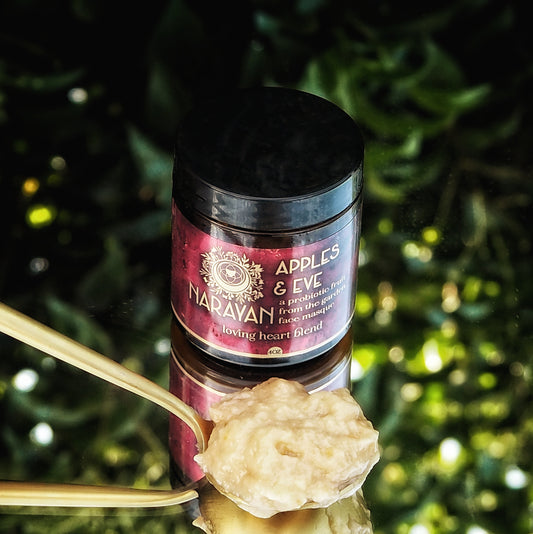
Apples and Eve contains SCOBY itself, and for a while that face mask behaved like an everlasting gobstopper. You could open the jar and discover that it had continued growing. There seemed to be more face mask than had originally gone into it.
Pop the lid and—surprise!—the product was coming to meet you.
It was funny, although perhaps not at the precise moment it happened.
But this is what genuine experimentation looks like. It is observation, failure, adjustment, patience and trying again. I watched how the kombucha behaved. I watched how it changed with age. I watched what it did inside different formulas and, most importantly, I watched how my own skin responded.
I had to do the research through the making.
Aging the Wildness
Eventually, I learned that the kombucha needed time.
Fresh kombucha was too busy. Too fizzy. Too interested in continuing its life inside the bottle.
Aging allowed that aggressive activity to settle. The kombucha became deeper, quieter and more acidic. It had moved beyond the cheerful sparkling drink most people recognize and into something closer to a mature herbal medium.
I wasn’t trying to kill its character. I was learning how to work with it.
There is a difference.
Formulating with a living ingredient requires a relationship. You cannot simply command it to behave like an inert industrial material. You have to observe its cycles, understand its movement and discover when it is ready to become part of something else.
Kombucha taught me that.
And after more than sixteen years, I have developed my own way of working with it—one learned through ruined batches, runaway fermentation, exploding bottles and countless experiments on my own skin.
This was not a technique handed down to me.
I had to find it.
The Skin Is an Ecosystem
We have been taught to treat the skin like a dead surface that needs to be scrubbed, stripped, corrected and covered.
But the skin is alive.
It has its own oils, acids, organisms, rhythms and methods of communication. It responds to the environment, the nervous system, hormones, food, weather, plants, touch and time.
It is an ecosystem.
That is why kombucha made sense to me as a skincare ingredient before I could find research explaining it. I was placing one complex living environment into relationship with another.
That does not mean every jar of drinking kombucha belongs on your face. It does not mean all “probiotic skincare” is the same. And it certainly does not mean that every product carrying the word fermented contains an active living culture.
The formulation matters.
The age matters.
The surrounding ingredients matter.
The skin matters.
And experience matters.
Kombucha’s acidity and fermentation products make it an intriguing cosmetic ingredient, but published research on topical kombucha is still limited. There are laboratory studies, cosmetic patents and a great deal of commercial enthusiasm, but that is not the same as having extensive human clinical evidence.
When I began, there was even less.
What I had was a question, a living culture and my own skin.
So I began there.
More Than a Beverage
Over the years, kombucha found its way through my apothecary.
I use it in tinctures and tonics. It appears in skin tonics, face serums and face masks. Sometimes I work with the aged liquid. Sometimes, as in Apples and Eve, I work with the SCOBY itself.
Kombucha can become a medium through which plants continue their transformation.
That may be the part that interests me most.
The plant has already lived one life in the soil. It has communicated with sunlight, water, minerals, weather and the underground intelligence surrounding its roots. Then it enters a fermented medium that is also alive and continues changing.
Plant intelligence meets microbial intelligence.
And eventually, it meets the intelligence of the body.
This is what I mean when I talk about plant-body intelligence. It is not one isolated “active ingredient” forcing the body to perform. It is a relationship among living systems.
Why the Skin Loves Kombucha
On the skin, aged green-tea kombucha works as both a botanical antioxidant infusion and a gentle acidic exfoliant. Its natural fermentation acids help loosen dull surface buildup and refine the appearance of the pores without the harsh, stripped feeling of conventional toners, while the green-tea polyphenols offer antioxidant support. The result is skin that looks clearer, brighter and more alive.
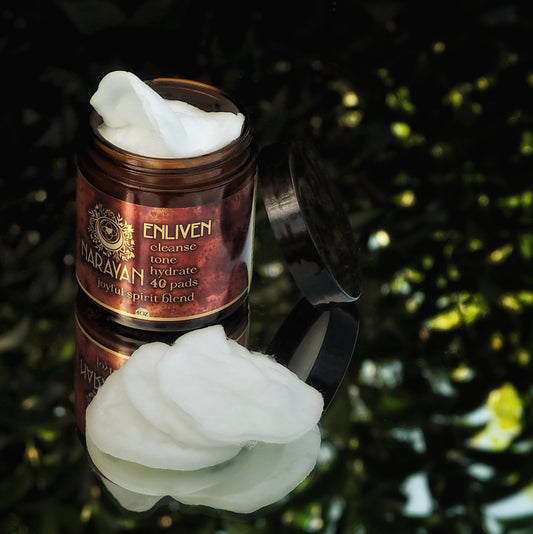
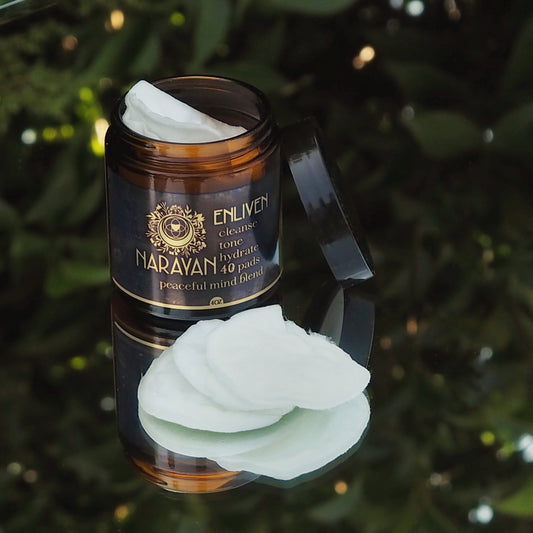
This is why kombucha became the foundation of my Enliven Cleanse Tone + Hydrate Pads. Each saturated pad sweeps away the day, gently resurfaces, tones and prepares the skin while the rest of the botanical formula restores hydration. It is cleansing, toning and treatment in one simple step.
Enliven has developed a definite cult following over the years—not because of who has used it or where it has appeared, but because people use it, see and feel the difference, and do not want to be without it.

Apples and Eve: The Everlasting Gobstopper
Apples and Eve may be the most unusual expression of my kombucha work. I layer thick slices of fresh apples between living SCOBYs, allow them to ferment together, and then purée the whole creation into a fresh, life-giving face mask.
That living activity is what makes this formula so unique. Apples and Eve crosses the usual skincare categories: it is especially helpful for congested, blemish-prone skin while also supporting mature skin, softening the look of fine lines and restoring freshness, clarity and vitality. It is clarifying and age-supportive at the same time—a fermented skin treatment unlike anything else I make.
Pomegranate Rose: The Whole Fruit
Pomegranate Rose Creamy Cleanser, from the RoseGold Collection, began with an enormous harvest of organic pomegranates and another one of my what would happen if… experiments.
I didn’t use a neat little cosmetic extract. I used the whole fruit—the jewel-like seeds, the juice, the flesh and, importantly, the skin. I cut the pomegranates into substantial pieces and slowly worked them into kombucha over very low heat for several days before puréeing the entire preparation into the foundation of this extraordinary creamy cleanser.
Most people discard the pomegranate skin, yet it is one of the fruit’s richest sources of polyphenols, including punicalagins, ellagic compounds, tannins and flavonoids. These compounds give the rind its remarkable antioxidant power and make it especially valuable for supporting clearer, brighter, firmer-looking skin.
Pomegranate Rose brings the antioxidant intelligence of the entire fruit together with fermented green-tea kombucha and rose in a cleanser that feels creamy and comforting while lifting away the day. It leaves the skin feeling clean without feeling stripped—soft, fresh, luminous and beautifully prepared for the rest of the RoseGold ritual.
Joyful Spirit: This Is What a Real Ferment Formula Looks Like
There is an enormous difference between adding a standardized fig-and-lemon ferment to a conventional formula and building an entire serum around kombucha you have brewed, aged and worked with yourself.
That long list of microbial names—Hansenula, Kloeckera, Lactobacillus, Lactococcus, Leuconostoc, Pediococcus and Saccharomyces—identifies organisms used to produce a commercial ferment. It sounds impressive, but it does not tell us whether the finished ingredient remains alive, has been filtered or lysed, or arrives as a preserved liquid or powder.
Joyful Spirit Affirmation Serum is something else entirely.
It begins with my organic kombucha, traditionally fermented from organic green tea and organic sugar. This is not a token “probiotic” added to an ordinary serum so that fermented can appear on the label. Kombucha is the botanical foundation of the formula.
Into that kombucha I steep calendula, self-heal, Bea Balm, Apricot Sprite, lemongrass lemon balm, spilanthes, lemon verbena and peppermint—not for a few hours or overnight, but for months. The plants slowly saturate the ferment, creating a concentrated botanical infusion in which the kombucha and herbs have had time to become something greater together.
That extraordinary infusion is what gives Joyful Spirit its living botanical depth.
Created for congested, temperamental and acne-prone skin, Joyful Spirit clears without trying to punish the skin into submission. Organic willow bark and lactic acid help loosen compacted surface cells, encourage fresh cellular turnover and clear the debris that can become trapped inside pores. With consistent use, this renewing action also helps diminish the appearance of post-blemish marks, old scars and uneven texture.
Organic neem, witch hazel, monolaurin and grapefruit seed extract deepen its clarifying action, helping the skin remain fresh, balanced and decongested. Organic green tea contributes its potent antioxidant character while helping soothe the visible redness and irritation that often accompany breakouts.
But acne-prone skin needs nourishment, too. Stripping the face can leave it inflamed, reactive and producing even more oil. Pumpkin seed oil, grapefruit seed oil, virgin coconut oil and lecithin replenish softness and support the skin’s protective barrier while the clarifying ingredients do their work.
Lemongrass, sweet orange, lemon, niaouli, tangerine, pink grapefruit and peppermint essential oils complete the formula with a bright, purifying and unmistakably alive aromatic presence.
Joyful Spirit works across the whole appearance of the complexion. It helps:
-
Clear and decongest the pores.
-
Lift away dead surface buildup.
-
Encourage fresh cellular turnover.
-
Balance the appearance of excess oil.
-
Calm visible redness and irritation.
-
Refine rough or uneven texture.
-
Diminish the appearance of post-acne marks and scars.
-
Restore a smoother, brighter and clearer-looking complexion.
Every batch is finished with mantra and Lemurian seed crystals as part of the beauty alchemy with which I have always made my products. Joyful Spirit is formulated for the physical skin, but it is also created for the person living inside it.
This is not a powdered probiotic sprinkled into glycerin and given a fashionable fermentation story.
Joyful Spirit is organic green-tea kombucha infused for months with whole plants, then layered with renewing acids, clarifying botanicals, nourishing oils and aromatic plant medicine. It is abundant, complex and unapologetically alive.
Because acne-prone skin does not need to be attacked.
It needs to be cleared without being stripped, renewed without being assaulted and cared for as a complete living terrain.
That is what Joyful Spirit was made to do.
3 Immortelles: The Holy Grail of Face Serums
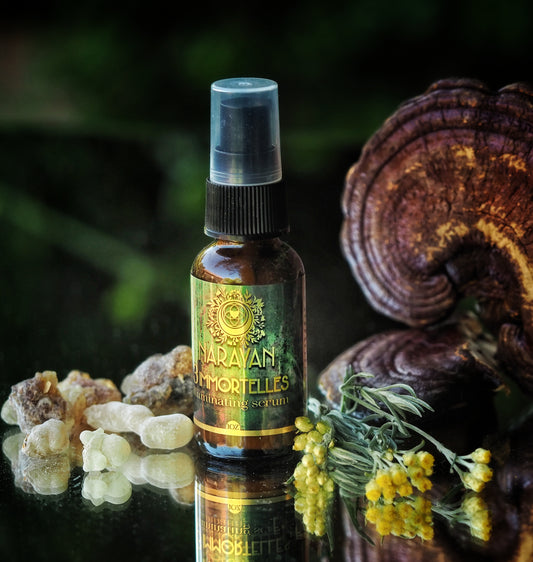
If Joyful Spirit is my great ferment for acne-prone skin, 3 Immortelles is the holy grail of my face serums.
It is frankincense, myrrh and gold—baby Jesus’s butt in a bottle.
At its heart is a spectacular five-mushroom ferment: organic chaga, reishi, cordyceps, tremella and lion’s mane, slowly fermented in Jun kombucha made from organic green tea and organic honey. I did not stir mushroom powders into a premade base and call it advanced skincare. The mushrooms are transformed within the Jun, bringing two ancient living kingdoms—fungi and fermentation—together in one deeply concentrated beauty elixir.
Chaga gives the serum its dark antioxidant richness and helps defend the complexion against the visible effects of environmental stress. Reishi, known as the Mushroom of Immortality, comforts dry, sensitive and visibly stressed skin. Cordyceps helps replenish a tired-looking complexion and supports a smoother, more vital appearance.
Tremella—the beautiful snow mushroom—is treasured for its remarkable moisture-binding polysaccharides. It drenches the skin in lightweight hydration, helping it appear plumper, softer and more supple. Lion’s mane brings another layer of antioxidant and restorative mushroom intelligence, supporting skin that looks calm, resilient and renewed.
Together, these five fermented mushrooms create a formidable complex for skin that is dry, depleted, environmentally stressed or beginning to show the visible passage of time.
Then the gold arrives.
Ormus Gold gives the formula its energetic center—an alchemical element associated with illumination, vitality and rejuvenation. Mineral-rich shilajit oil brings its earthy depth, conditioning and nourishing the complexion.
Finally, there is organic helichrysum—Immortelle itself—grown in my garden. This remarkable golden flower has long been treasured for mature, delicate and visibly damaged skin. It helps soothe the appearance of redness while softening the look of fine lines, scars and uneven texture.
3 Immortelles helps the skin appear:
-
Deeply hydrated, plump and supple.
-
Brighter and more luminous.
-
Calm, nourished and replenished.
-
Smoother and more refined.
-
Firmer and more resilient.
-
More even in tone and texture.
-
Softer in the appearance of fine lines and scars.