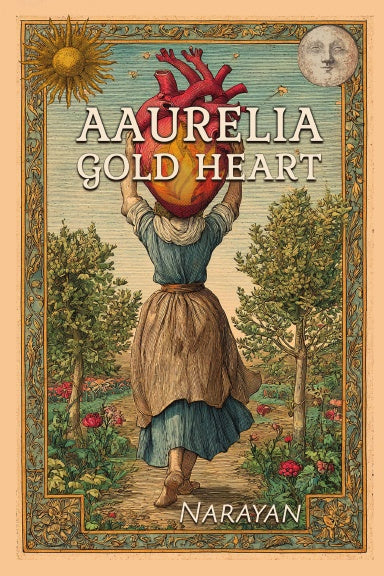
new the gold heart meditation ☆~♡~ aaurelia gold heart , a novel by narayan , read it!~☆~♡in the living library crone with a machete !☆~♡~astro scope in the living libraray ~♡~
The Heart as Sacred Ground: On the Chamber That Remembers Everything
There is a room in the body that no one built. It was there before the first breath, before the name was given, before the mind learned to measure and divide the world into safe and unsafe. It sits behind the sternum, low and warm, and it has been beating out its steady rhythm since roughly six weeks after conception — before there was a brain to command it. The heart begins its work in the dark, unsupervised. It does not wait for permission. It does not wait for understanding. It simply starts, and it does not stop, and in this way it is the oldest sacred space any of us will ever inhabit.
We have spent so many centuries looking upward for the sacred — to steeples, to mountaintops, to distant stars — that we forgot to look inward, six inches down and slightly left, to the temple that travels with us. But the mystics never really forgot. The Sufis called it qalb, the heart-cave where God waits to be discovered. The Egyptians weighed it against a feather to determine the truth of a life. The old alchemists placed their furnace not in some external laboratory but in the chest, understanding correctly that the true transmutation — lead into gold, wound into wisdom — happens nowhere else.
This is not a metaphor. This is not a "connection" in the small sense the word has been reduced to. This is a chamber.
What Neuroscience Cannot Touch
In recent decades, neuroscience has turned its instruments toward the heart, and something strange has happened in the process: an experience that mystics spent millennia approaching with reverence has been quietly repackaged as data. A screen. A waveform. A rating that confirms you've "made the connection," as though the sacred could be certified by a sensor, as though awe were a metric waiting to be captured.
This is not a neutral act of discovery. It is a diminishment — and not, despite its language of wellness and optimization, one made for humanity's benefit. What is profound gets flattened into what is measurable. What is awe-inspiring gets rebranded as a biometric. And once something can be plotted on a graph, the culture starts to believe the graph is the thing — that the experience is exhausted by whatever the machine can register.
But the sacred space of the heart was never waiting for confirmation. It does not require a device to certify that you have arrived, because no device built by human hands will ever be capable of reaching where you have gone. Technology can track a heartbeat's rhythm. It cannot touch the chamber the rhythm merely echoes from. It can register a pattern. It cannot resonate with what the pattern is a shadow of. To claim otherwise — to insist that a sensor has monitored the sacred, that a waveform has captured the mystical — is not just a misunderstanding. It is, at its root, a kind of lie: a story sold to a culture starving for meaning, offering it a screen instead of a chamber.
The heart does not perform for instruments. It opens for reverence. And reverence has never once shown up on a printout.
Entering the Chamber
To actually enter the sacred space of the heart is not to think warm thoughts at your chest and call it healing. It is to cross a threshold. Beneath the muscle, beneath the blood, there is a chamber that holds more than any single lifetime could have put there — ancient wisdom, encoded memory, information that did not originate with you and will not end with you. This is not sentiment. This is architecture. A structure built long before language, holding what language has never been able to hold.
When you actually arrive there — not skim the surface, not visit for a moment of gratitude before returning to the noise of the mind, but truly enter — something ancient turns to meet you. The chamber does not need to be convinced you deserve to be healed. It has been waiting, the way a locked room waits, for someone to finally come home to it.
This is why so much of what passes for heart-work today feels thin. It measures a rhythm and calls it depth. It reduces an entire cosmology down to a wave pattern and hands it back to you smaller than it was. But the heart was never a mechanism to be optimized. It is older than optimization. It is closer to a temple buried beneath a temple — the one the ancients were pointing to when they built their outer sanctuaries, hoping stone might eventually remind us of what flesh already carried.
The Heart That Flips Outward
There is a way the heart moves when it is truly entered — not gently opening like a door left ajar, but flipping outward entirely, turning itself inside out the way a flower does not so much bloom as erupt. In that moment, what is written upon it becomes visible: sacred syllables, Sanskrit etched into the muscle itself, ancient sound made flesh. Om. Hrim. Words older than the tongues that first spoke them, carried not in memory but in matter.
This is the self-healing that no external practice can manufacture. It cannot be induced by technique. It can only be entered. And once entered, the wound does not need to be managed or processed or worked through in the way the mind understands work. It is met by something vast enough to hold it entirely — met by the chamber itself, which has been holding far larger things than your grief since long before your grief arrived.
The Heart as Generator, Not Just Receiver
But the heart does not only heal what has already happened. It generates what has not yet arrived.
Every tradition that has taken the heart seriously has understood it as a place of creation, not just recovery — a womb-space rather than merely a wound-space. The heart is where intention takes on gravity, where a wish stops being a thought and becomes a pull. This is why prayer, in nearly every lineage, is directed through the chest rather than the skull. This is why the old grimoires speak of "heart's desire" as though desire itself is homeless until the heart gives it a body.
To use the heart as an evolutionary space is to stop treating it purely as an archive of pain and start treating it as the chamber it actually is — vast, ancient, generative. What would it mean to sit daily not to process what hurt you, but to enter that room and let what is already written there rise to the surface? Not visualization as a mental trick, but as a return: allowing the syllables etched into the heart to surface into the body's felt experience, ahead of any evidence the mind requires.
This is not naive optimism. It is closer to excavation. You are not building something new. You are clearing the dust from something that has been there the entire time, waiting to flip outward and show you what it has always known.
A Daily Practice for a Shaking World
We are living inside a transmission. The Schumann resonance climbs and spikes in ways it never used to; the astrological alignments overhead grow denser, more insistent; and something in the body has begun to answer back. Many are feeling it now — a vibration underneath the skin that has no clear source, arriving as anxiety that seems to come from nowhere, unexplained heat moving through the body, a frustration with no clear target, a fear that won't name itself. This is not malfunction. This is the body being shaken loose from what it no longer needs to carry, and it will keep shaking until that release happens one way or another.
That is the choice hidden inside the discomfort: you can suffer through the shaking, white-knuckled, treating it as something being done to you — or you can go into the heart and transmute it, treating it as something moving through you toward release. The anxiety, the heat, the frustration, the fear — none of it needs to be fought or fixed. It needs somewhere to go. And the chamber behind your sternum is built to receive exactly this.
This is where the daily return to the heart becomes not a luxury but a necessity. Each day, sit. Place a hand on the sternum, or simply bring your attention there the way you'd turn toward a familiar doorway. And ask — not as performance, not as a phrase to recite, but as a real question offered to something that can actually answer:
Show me what I cannot see.
We all carry blind spots — rooms within the chamber we have not yet been willing to enter, corners the mind has quietly agreed never to illuminate. The heart knows exactly where they are. It has always known. What it has been waiting for is your permission to show you, and your willingness not to flinch from what it reveals.
Ask, and then wait the way you'd wait for an old friend to finish gathering their thoughts. What surfaces might not arrive as words. It may come as a memory, an image, a sudden ache in a part of the body you'd forgotten, a wordless knowing that settles rather than announces itself. Trust it regardless of the form it takes. This is how the chamber speaks — not in explanations, but in revelations.
Do this daily, and the shaking begins to change character. It stops being something happening to you and starts being something moving through you — the anxiety transmuting into clarity, the heat into aliveness, the frustration and fear finally finding the door out instead of pacing the same room. The ascension the planet is undergoing and the ascension the body is undergoing are not two separate events. They are the same wave, and the heart is the one instrument capable of translating it without breaking.
An Invitation Into the Space Itself
Reading about the chamber is not the same as entering it. And for many, the first crossing needs a hand to hold — not a technique, not a script, but a voice already familiar with the way in.
This is what the Gold Heart Meditation was made for. It is not a guided visualization in the usual sense. It carries you, in voice and music, to the very edge of the chamber — and then it does something most meditations are too impatient to do: it stops guiding. It drops you into the space and lets you sit there, unrushed, so that the heart itself can begin to teach you what no outside voice ever could. You are not told what you'll find. You are simply brought to the door, and then trusted — as the heart has always trusted you — to walk through it and learn its language on your own terms.
This is the practice this essay has been pointing toward all along. The words here can describe the chamber. Only the meditation can bring you into it.
My heart to yours
Narayan
Share
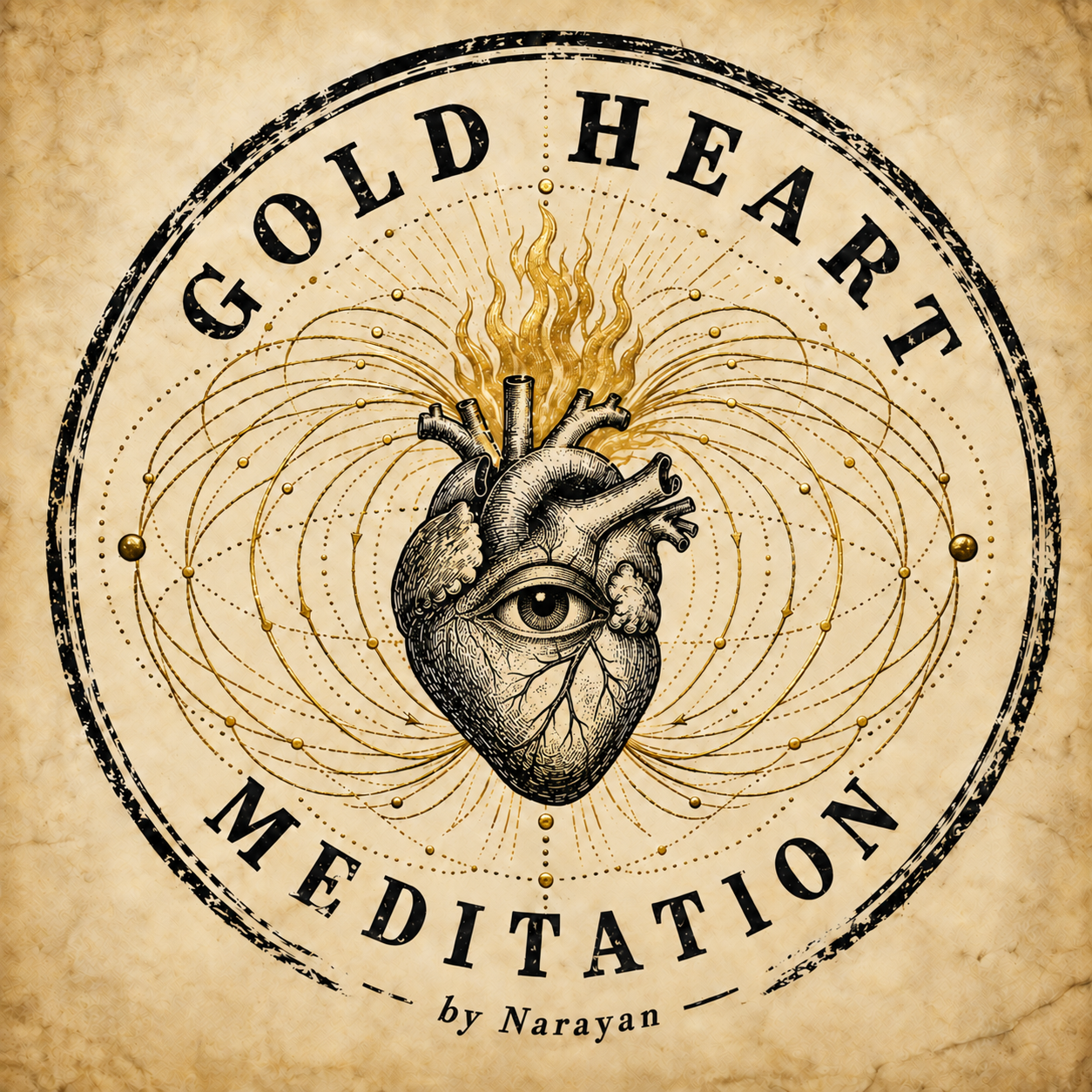
GOLD HEART MEDITATION
If the eye of the heart is the lens through which we remember the greater cosmology, then the Gold Heart Meditation is an invitation to enter it. This guided journey takes you beyond the noise of the mind and into the living chamber of the heart, where you can breathe, feel, listen, and remember. The road home was never somewhere outside you. It has been waiting within the heart all along.